All Categories
Featured
Table of Contents
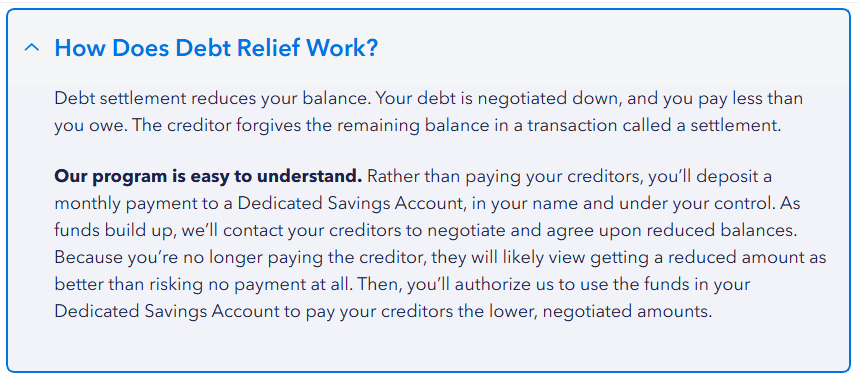
That liberates cash in the brief term, and you may have 3 to four years to save towards the negotiation amount. Extremely unsafe to credit rating, mostly due to missed out on repayments and an adverse "settled" mark that could remain on your credit score record for approximately 7 yearsMay be just choice if various other alternatives (financial obligation consolidation, equilibrium transfer charge card, financial obligation forgiveness) aren't possibleTypically calls for a fee to the 3rd party, which could balance out some or all of the financial savings from debt settlementMay aid you avoid personal bankruptcy if you have actually missed out on a number of paymentsNot all financial institutions deal with financial debt negotiation firms Financial obligation forgiveness might be best for you if you are experiencing a monetary challenge that makes it virtually difficult to pay for your financial obligation balances.

With a DMP, you make one month-to-month repayment to the credit score therapy agency. Those funds are after that dispersed to lenders of your unsecured financial debts, such as bank card and installment fundings. The firm works with your lenders to minimize passion rates or forgo charges, however some lenders might decline such giving ins.
It can aid you pay down financial obligation if you're able to secure a financing rate that's lower than the typical price of the accounts you're combining. You must refrain from racking up financial debt on those recently cleared accounts or your debt might expand also greater.
That offers you lots of time to get rid of or significantly lower your balance while making interest-free settlements.
The Only Guide to Understanding Expert Financial Advice
You might need it if your financial institution or a debt collector ever attempts to accumulate on the financial obligation in the future. The letter might prove you don't owe what the collection company's documents show. Yes, for the most part, the IRS considers forgiven financial debt as gross income. When a lender forgives $600 or even more, they are called for to send you Kind 1099-C.
Financial obligation mercy or settlement usually hurts your credit history. Anytime you resolve a financial debt for less than you owe, it may look like "resolved" on your credit score report and impact your credit report for seven years from the day of settlement. Your credit scores can likewise go down considerably in the months bring about the mercy if you fall back on repayments.
The 20-Second Trick For Required Documentation for Bankruptcy Counseling
This scenario frequently results from underreporting earnings, not filing returns on time, or discrepancies located during an Internal revenue service audit. The consequences of building up tax financial debt are significant and can consist of tax obligation liens, which give the IRS a lawful case to your building as security for the financial debt.
Salaries and Financial institution Accounts Internal revenue service can impose (seize) earnings and financial institution accounts to please the debt. Residential property Seizure In extreme cases, the IRS can confiscate and sell residential property to cover the debt.
Clinical depression, anxiety, and other psychological health concerns. Social Stigma Facing legal action from the IRS can lug social preconception. Damages to reputation and partnerships. Employment Opportunities A bad credit history as a result of tax debt can limit job opportunity. Problem searching for or keeping a task. Federal government Benefits Tax obligation financial debt might influence eligibility for federal government advantages, such as Social Safety And Security and Medicaid.
Staying Away From Future Debt Cycles After Debt Relief Can Be Fun For Anyone
The OIC thinks about several factors, including the taxpayer's earnings, expenditures, asset equity, and capability to pay. Efficiently working out an OIC can be intricate, requiring a thorough understanding of the IRS's guidelines and a solid debate for why your offer straightens with your capacity to pay. It is essential to keep in mind that not all applications are accepted, and the procedure calls for detailed monetary disclosure.
The IRS assesses your general monetary situation, including your revenue, expenditures, asset equity, and capacity to pay. You should additionally be existing with all filing and repayment demands and not be in an open insolvency case. The IRS likewise considers your compliance background, assessing whether you have a record of timely filing and paying tax obligations in previous years.
See This Report on The Pros to Consider of Bankruptcy
The application procedure for an Offer in Concession includes numerous detailed actions. You must complete and submit Internal revenue service Type 656, the Deal in Concession application, and Form 433-A (OIC), a collection details declaration for individuals. These kinds call for detailed economic details, including details concerning your earnings, financial obligations, expenditures, and possessions.
Back taxes, which are unpaid taxes from previous years, can dramatically raise your complete IRS debt otherwise attended to immediately. This debt can build up interest and late repayment penalties, making the original quantity owed much bigger over time. Failure to pay back tax obligations can result in the IRS taking enforcement actions, such as issuing a tax obligation lien or levy against your property.
It is necessary to resolve back tax obligations immediately, either by paying the sum total owed or by organizing a layaway plan with the IRS. By taking positive actions, you can prevent the build-up of added passion and charges, and prevent extra aggressive collection actions by the internal revenue service.
One common reason is the belief that the taxpayer can pay the sum total either as a lump amount or via a layaway plan. The internal revenue service likewise takes into consideration the taxpayer's income, expenditures, possession equity, and future earning potential. If these variables show that the taxpayer can manage to pay more than the provided amount, the IRS is likely to reject the offer.
How Understanding Your Legal Options Regarding Housing Counseling Services : APFSC Guidance for Homeownership can Save You Time, Stress, and Money.
Dealing with IRS financial debt can be intricate and challenging. Tax specialists, such as CPAs, tax obligation lawyers, or signed up agents, can supply invaluable aid.

Table of Contents
Latest Posts
All about Pricing Transparency That How to Use Credit Cards Wisely to Avoid Debt : APFSC Experts Disclose
What Does Policy Changes That Will Change Debt Relief Procedures Mean?
Excitement About Staying Safe from Dishonest Companies
More
Latest Posts
All about Pricing Transparency That How to Use Credit Cards Wisely to Avoid Debt : APFSC Experts Disclose
What Does Policy Changes That Will Change Debt Relief Procedures Mean?
Excitement About Staying Safe from Dishonest Companies